

BNIM’s 2030 Commitment: Three Years Running
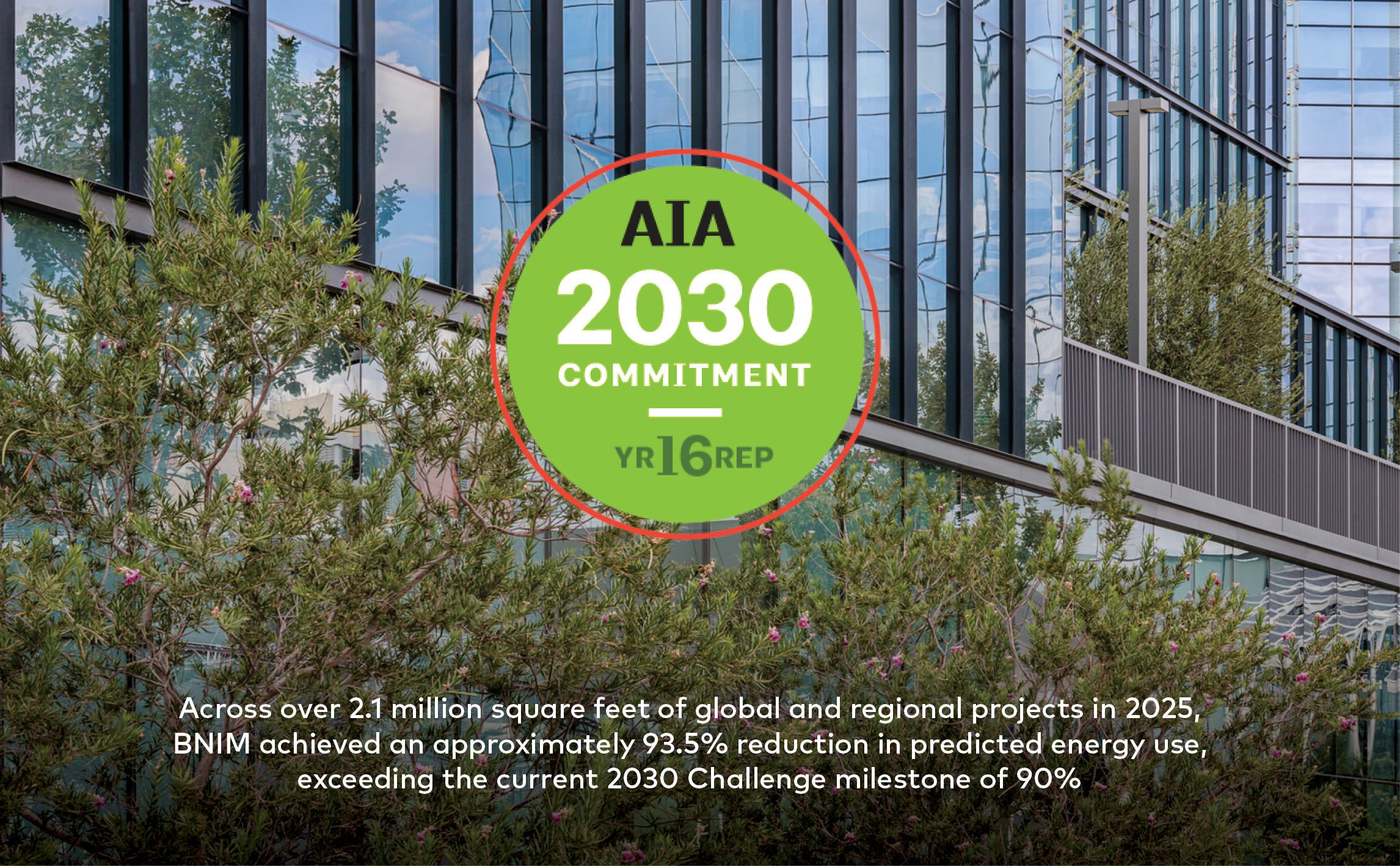
This Earth Day, BNIM reports that for the third consecutive year, our portfolio of projects in design has met the AIA 2030 Challenge. Across over 2.1 million square feet of global and regional projects in 2025, we achieved an approximately 93.5% reduction in predicted energy use compared to the CBECS 2003 baseline, exceeding the current 2030 Challenge milestone of 90%.
Our 2025 portfolio produces an estimated operational energy demand causing site-level emissions of just 285.52 MT CO2e annually, representing roughly 4,100 metric tons of carbon avoided compared to baseline. That is equivalent to the carbon sequestered by nearly 3,900 acres of forest each year. [EPA Greenhouse Gas Equivalencies Calculator]
These results reflect sustained attention to building envelope performance (walls, windows, and roofs), high-performing HVAC systems, and on-site and procured renewable energy. Together, these strategies continue to move our portfolio toward net-zero energy by, or before, 2030.
Operational energy is only part of the picture. As the AEC industry matures in its ability to model embodied carbon, our understanding of the impact of materials like concrete, steel, aluminum, glass, and higher-churn interior finishes continues to grow. In 2025, BNIM joined a small group of firms working with C.Scale to advance full carbon accounting for design and construction teams, and we have continued to refine total carbon modeling across our portfolio.
Central to this progress is the Summit MethodSM, an internal framework that helps our teams set energy and decarbonization goals early in design, test them through modeling and financial analysis, and protect those goals through construction and value engineering. The Summit Method is a key reason our performance targets are holding through delivery.
This year’s results reflect the work of every project team across BNIM and the willingness of our clients to pursue meaningful performance. The 2030 Challenge has always been about demonstrating that high-performance design is standard practice, teaching us that the choices made in every project compound into outcomes that matter.