The Kansas City Cultural EcoDistrict: A Framework for Protecting Culture for Future Generations
A Legacy of Action by People Just Like Us
“To communicate and preserve culture and knowledge for future generations.”
This is the North Star statement of the Kansas City Cultural EcoDistrict, a year-long collaboration between the Nelson-Atkins Museum of Art, Linda Hall Library, and a consulting team led by BNIM and GDS Engineering, with support from Armstrong Collaborative, MAC Water Technologies, and SunSmart Technologies. The EcoDistrict is a first-of-its-kind effort to help Kansas City’s most significant arts and cultural institutions prepare for future resilience, together, through shared measurement, coordinated planning, and a framework designed to be adopted by peer institutions locally and across the country. Today, BNIM shares the tools, findings, and framework from that effort at ecodistrict.bnim.com.
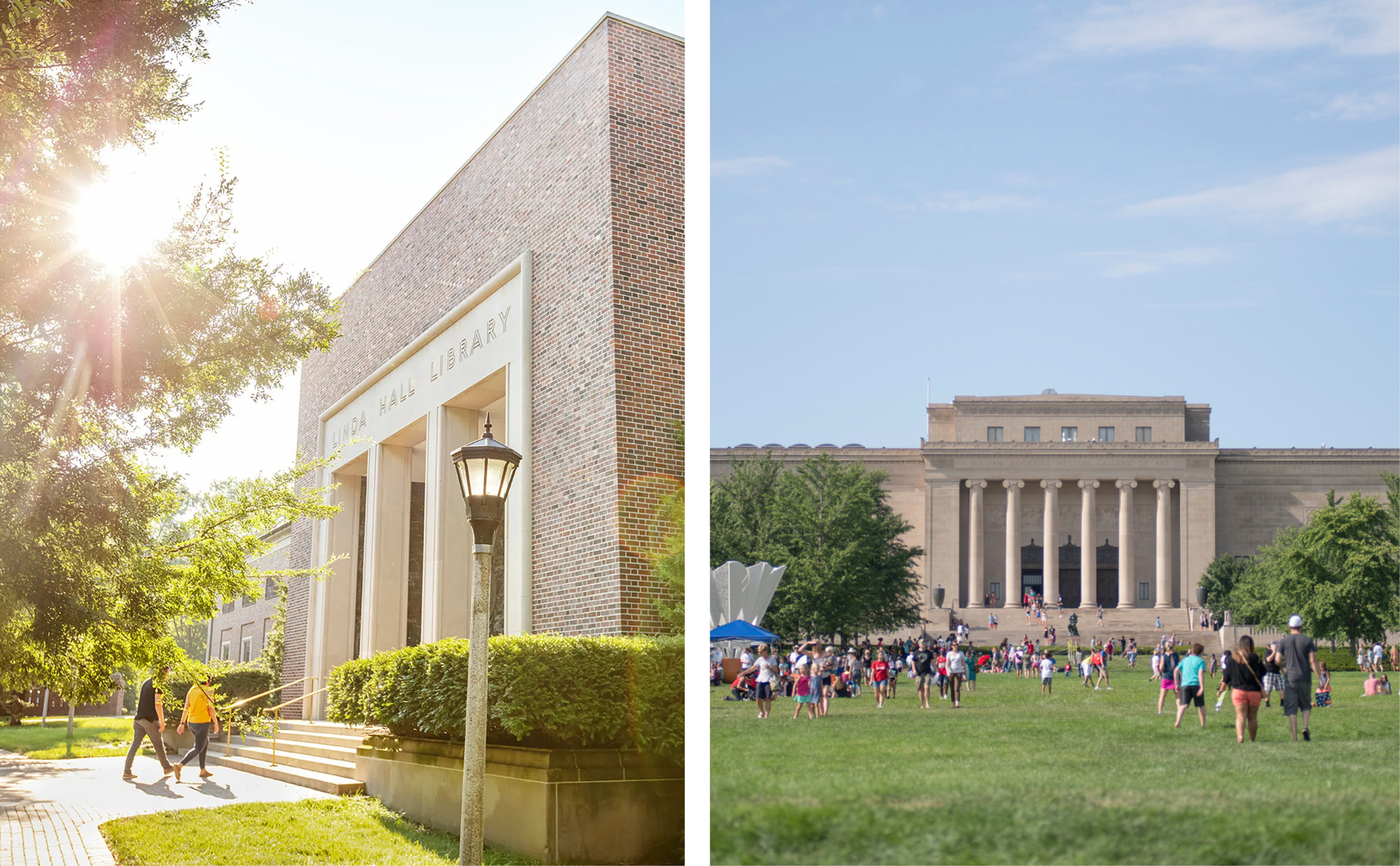
Images courtesy of Linda Hall Library (pictured left) and The Nelson-Atkins Museum of Art (pictured right).
The Nelson-Atkins has a direct, personal connection to the work of protecting cultural institutions and the irreplaceable collections they hold. The Museum’s first director, Paul Gardner, and its second director, Laurence Sickman, both served during World War II as Monuments Men. This group of architects, curators, librarians, and scholars from 14 nations worked to protect and recover the cultural treasures of Europe. Roughly 345 men and women helped return over 5 million items to their countries of origin: paintings, sculptures, Torah scrolls, church bells, and entire library collections. Learn more about Nelson-Atkins’ Monuments Men and the Monuments Men and Women Foundation.
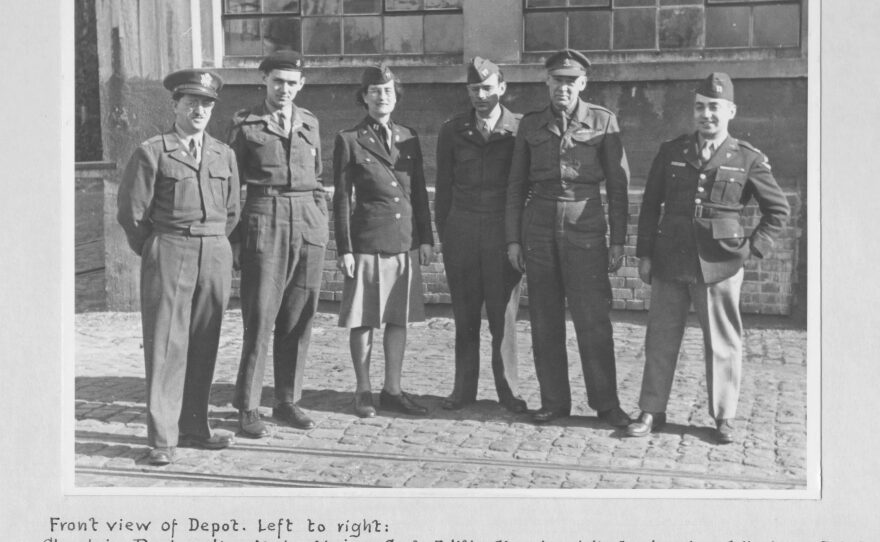
Image courtesy of The National Archives and Records Administration. Originally published by KCUR in Saving Art From War: The Monuments Men
The Monuments Men and Women were professionals doing the same kind of work many of us do today, under the most extreme circumstances imaginable. Their actions were courageous, necessary, and entirely reactive; an almost-too-late response to an immediate threat. But what made their work lasting was not a single dramatic act. It was the accumulation of small, informed decisions, often unglamorous, where the easy choice and the right choice were rarely the same.
But what does a museum, or a library of rare books, do about the slowly unfolding risks that are hard to recognize, let alone act upon with immediacy? When institutions are operating normally, keeping up with maintenance, planning expansions, and living in their missions, how do we move from reaction to preparation?
What Disaster Recovery Teaches Us
Over 30 years, BNIM has learned and shared lessons about three types of disruption:
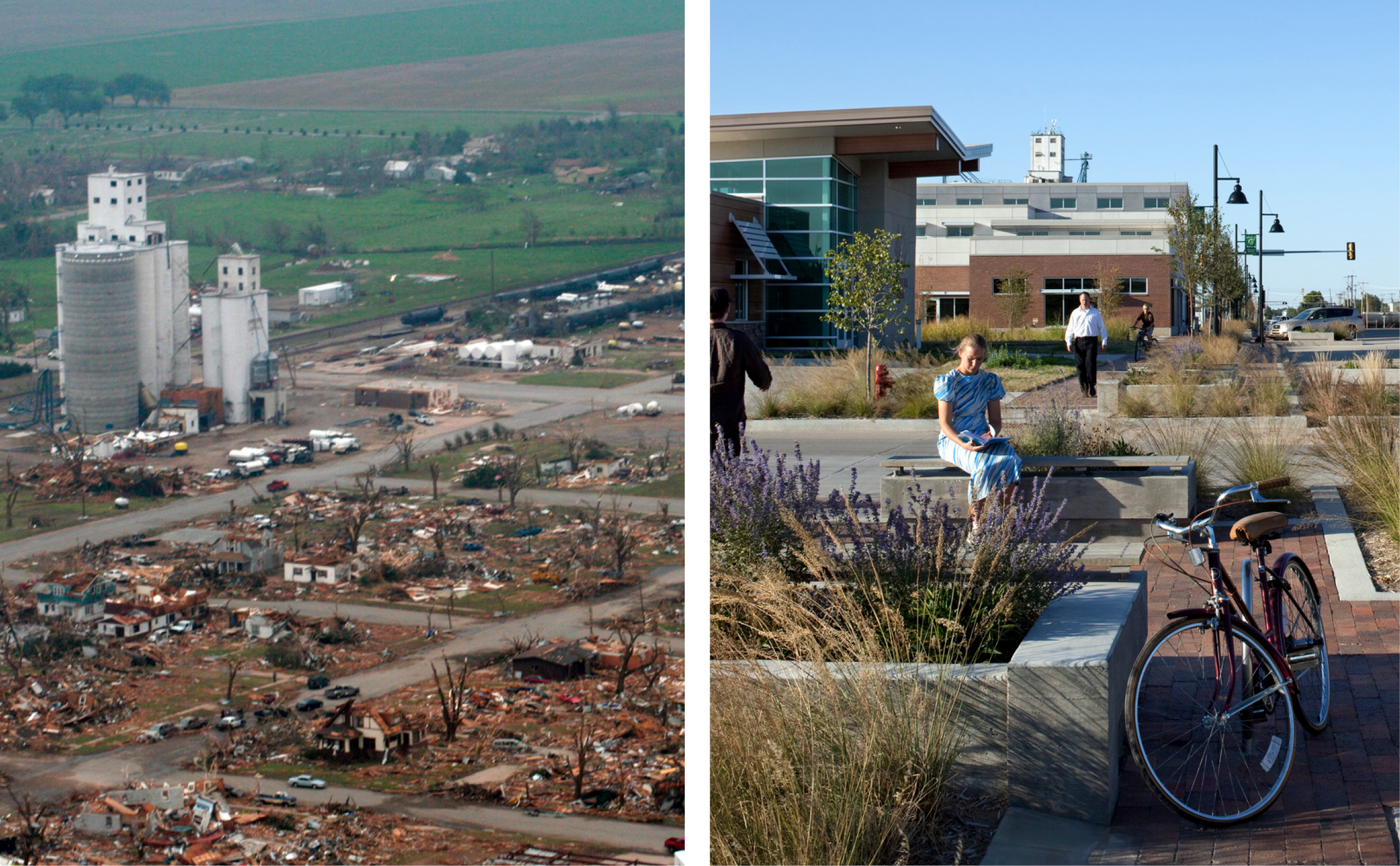
Greensburg, Kansas, following a devastating EF-5 tornado in May 2007 (pictured left) and Greensburg Main Street after implementing a sustainable comprehensive master plan to rebuild all city projects to LEED Platinum standards (pictured right)
1. Sudden destruction. BNIM has worked with towns, neighborhoods, and cities across America impacted by natural disasters, including Riverside, Missouri, New Orleans, Louisiana, Nashville, Tennessee, Greensburg, Kansas, Maui, Hawaii, Hamburg, Iowa, and many more. The initial press after a tornado, flood, or fire is often to rebuild exactly what existed before, but in our experience, establishing a clear vision for a better future is a critical step. It helps a community build toward something, rather than repeating the development patterns that compounded vulnerability in the first place.
2. Slow disinvestment. Recovering from a legacy of economic distress and blight is an even more difficult kind of disaster, because there is rarely an immediacy to take action. Often there’s a notion “that’s just the way things are,” but in communities like Historic Manheim Park in Kansas City, Missouri, we found that establishing a vision for what could be, and naming both the strengths and challenges of a place, can be the foundation for building a brighter future. Projects like the Bancroft School and Ladd School redevelopments demonstrate how community-inclusive development can spark reinvestment and signal that a corner has been turned.
3. The disaster that hasn’t happened yet. This is the hardest one to act on. We all have a tendency to maintain the status quo when “it ain’t broke,” but there is real risk in standing still. Statistical risks of extreme weather compound alongside aging infrastructure, and small vulnerabilities quietly accumulate. For institutions like the Nelson-Atkins and Linda Hall Library, that accumulated risk shows up in utility bills, emergency exhibit closures, and small but steady costs that take funds away from mission-aligned programs. Deferred maintenance and operational workarounds pile up until the problem is larger and more costly to address than it ever needed to be.
The EcoDistrict (And You Can Too!)
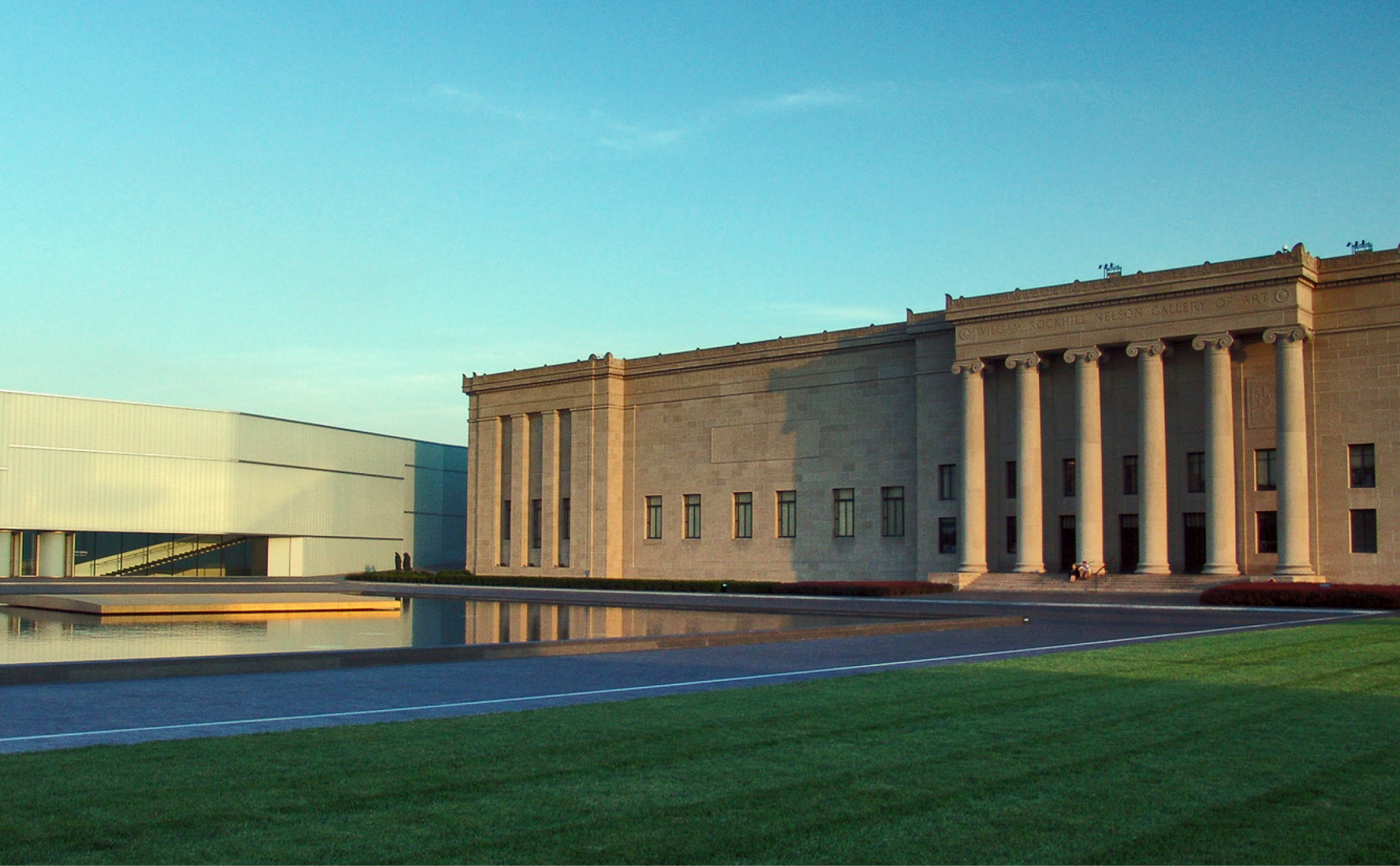
The Nelson-Atkins Museum of Art began to address institutional resilience in 2019, following a summer of exceptionally high water bills. By rethinking the irrigation system and shifting to a performance landscape contract, the Museum reduced irrigation demand by roughly 10 million gallons by 2022. Through subsequent conversations about building systems, we discovered that escalating utility costs and insurance, combined with increasingly frequent demand spikes from extreme weather, had begun to erode the Museum’s budget for programs, taking funds from the mission. Recognizing this challenge offered an opportunity to create a better outcome.
In 2023, the successful pursuit of a National Endowment for the Humanities Climate Smart grant, one of only five awarded nationally, provided an opportunity to formalize that conversation. The project brought together the Nelson-Atkins and neighboring Linda Hall Library as two anchor institutions of very different sizes and types, along with a broader coalition including the Kansas City Art Institute, Rockhurst University, University of Missouri-Kansas City, the Kemper Museum of Contemporary Art, the Toy and Miniature Museum, the Stowers Institute, and more.
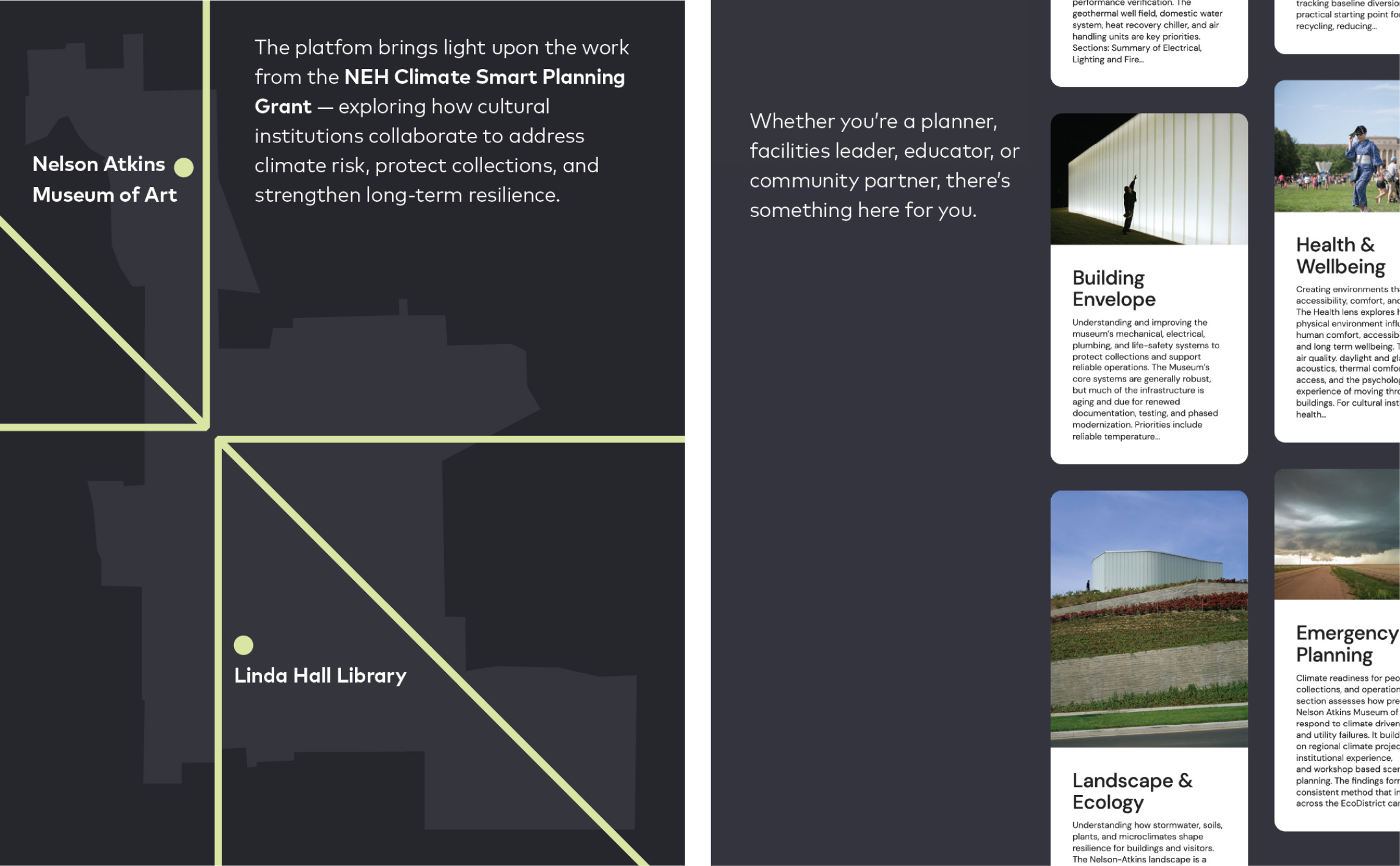
The resulting framework, now published at ecodistrict.bnim.com, evaluates institutional risk and readiness across six pillars:
- Building Systems: mechanical, electrical, water, and related systems that keep collections safe and operations running
- Building Envelope: air leakage, moisture control, and glazing performance that directly affect preservation and operating costs
- Landscape & Ecology: stormwater, soils, tree canopy, and microclimates that shape resilience for buildings and visitors
- Health & Wellbeing: air quality, thermal comfort, accessibility, and the daily experience of staff and the public
- Emergency Planning: readiness for utility disruptions, extreme weather, and coordinated response across institutions
- Waste Stream: baseline tracking, diversion strategies, and procurement alignment
Each pillar includes specific findings, recommended priorities, and a clear sequence for action, starting with high-impact, low-risk measures and building toward deeper investments over time. Taken together, they help decision-makers evaluate choices beyond first cost, understanding how a single investment in building systems or envelope performance affects operating budgets, collection safety, and program funding for decades.
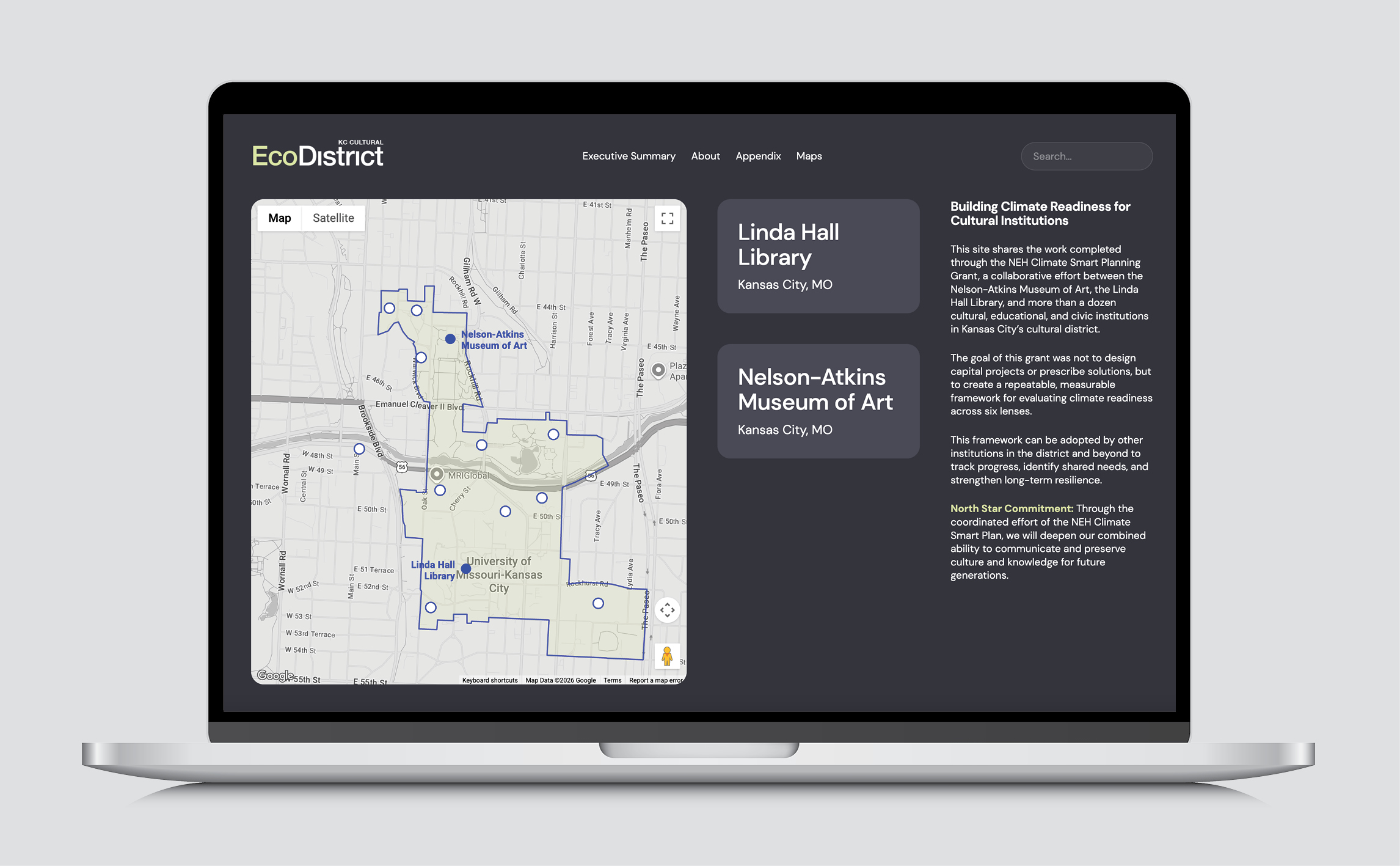
The website includes:
- An executive summary of findings and recommended priorities
- Separate lessons for libraries and museums
- Institution-specific assessment pages for the Nelson-Atkins and Linda Hall Library
- Interactive maps of the cultural district
- A detailed appendix of data and methodology
The entire framework is designed to be transferable so that peer institutions can adopt the same approach to understand their own risks, prioritize investments, and work with their neighbors.
Beyond the metrics and accounting, this work remains rooted in its North Star: to communicate and preserve culture and knowledge for future generations. Delivering on that mission requires daily decisions by many people, who need a shared understanding of how their choices connect to that goal. It also requires institutional courage to choose the path that serves the institutional value and mission over the long term; rising above the tempting short-term lower cost (and lower value) investment options.
If any of this resonates, the best way to get started is to review your own institution’s mission and ask where daily choices are supporting or quietly eroding your ability to rise to that calling. The resources are open, the framework is designed as a resource for other institutions, and the conversation is easier to start than you think.